
For companies entering the UAE e-invoicing market
Become a UAE Peppol access point.
Every business in the UAE will need an accredited service provider. Just over forty providers are on the Ministry of Finance list today. We give you the entire platform, deployed in your own cloud, and help you through accreditation.
59/59 passedAll 7 OpenPeppol Testbed suites. See the results10 videos · 48 minWatch the full product walkthroughThe opportunity
A mandated market, with a deadline and very little supply.
UAE e-invoicing runs on Peppol. Businesses cannot exchange compliant invoices without going through an accredited access point, and they have to appoint one on a published timetable.
Demand is compulsory, not discretionary
Your customers are not choosing whether to do this. The mandate decides that. They are only choosing who does it for them.
Revenue recurs per participant
An access point earns on every business it onboards and every document that moves, not on a one-off licence.
Switching costs favour whoever is first
Moving between providers means re-registering participants and handing over a migration key. Businesses do it once and stay.
The firms best placed to do this are the ones that already hold the client relationship: accounting and audit practices, tax consultancies, ERP partners and system integrators. Several UAE accounting firms are already on the accredited list.
Accreditation
We get you through certification.
Peppol accreditation and the UAE's Ministry of Finance listing are the gate. Most of that gate is technical evidence, which is exactly what a working platform gives you.
- Technical conformance testing against the pilot environment, using the same stack you'll run in production
- SMP registration and participant onboarding, automated end to end
- The architecture and security documentation the accreditation pack asks for
- A working demonstration of the full lifecycle, which is what most applications get stuck on
To be precise about what this is: we are not the accrediting body and we cannot approve anyone. Accreditation is granted to you, in your name, and the commercial relationship with your customers is yours. What we remove is the part where you have to build and prove the technology first.
Proof
Already through the OpenPeppol Testbed.
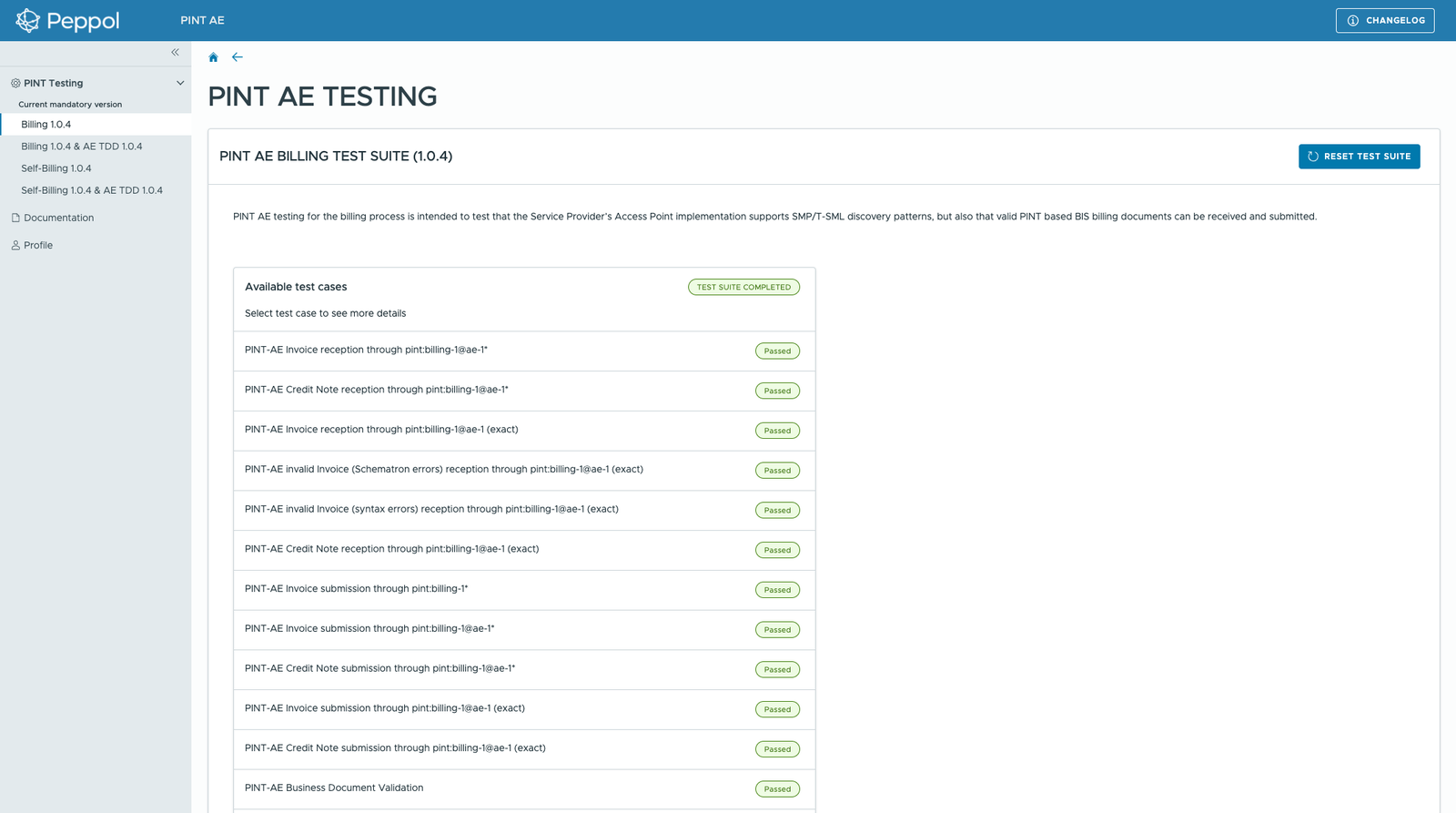
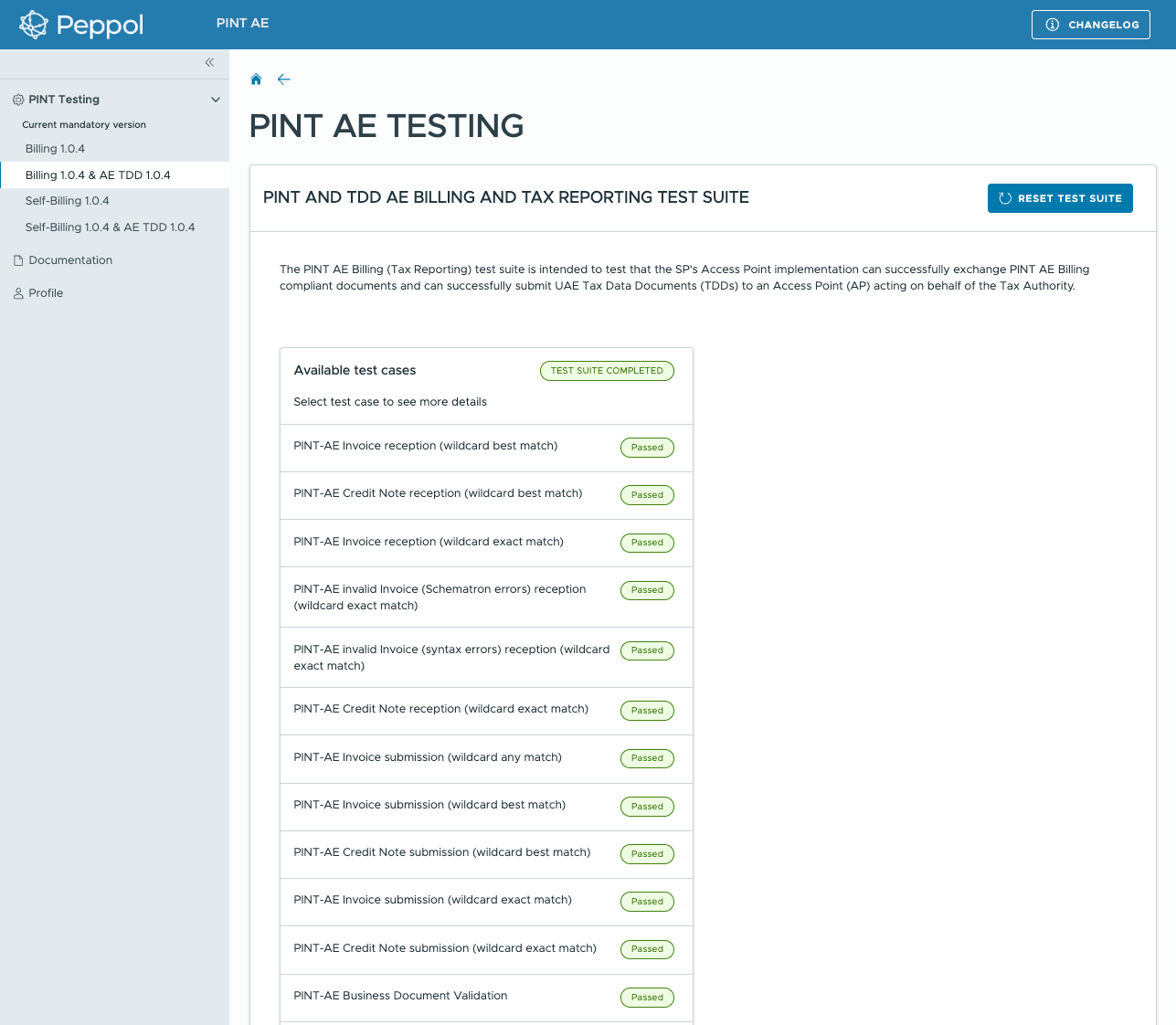
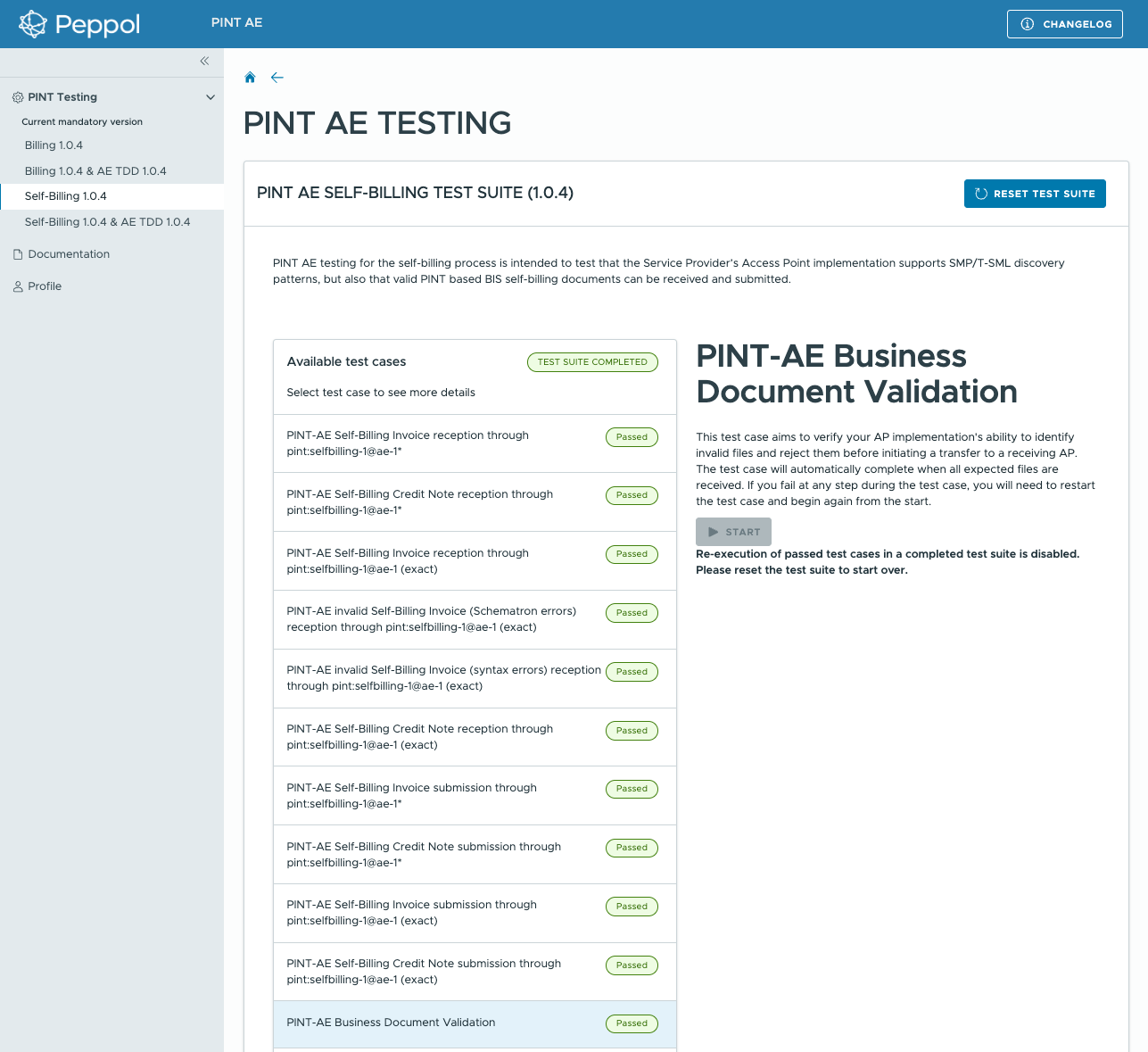
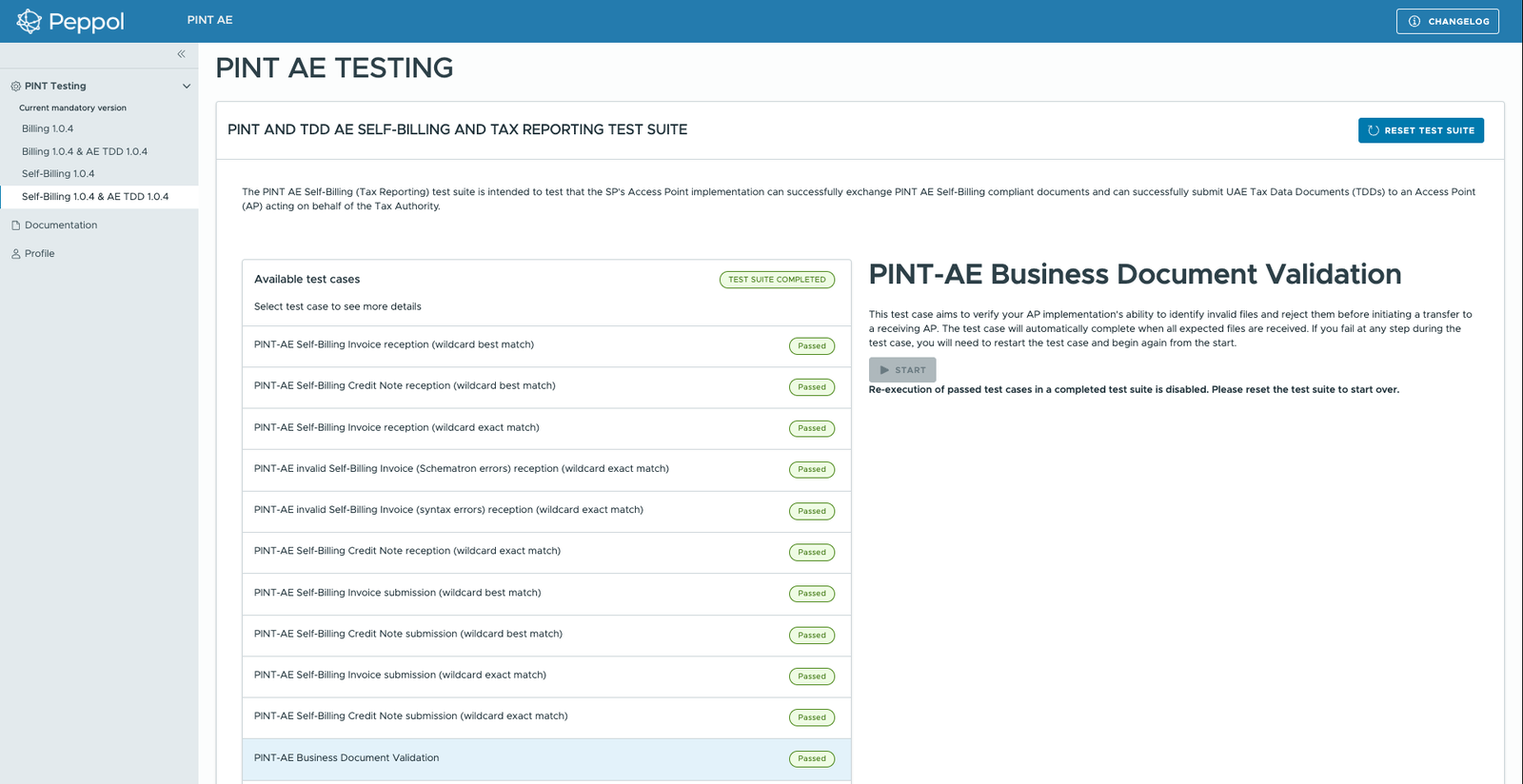
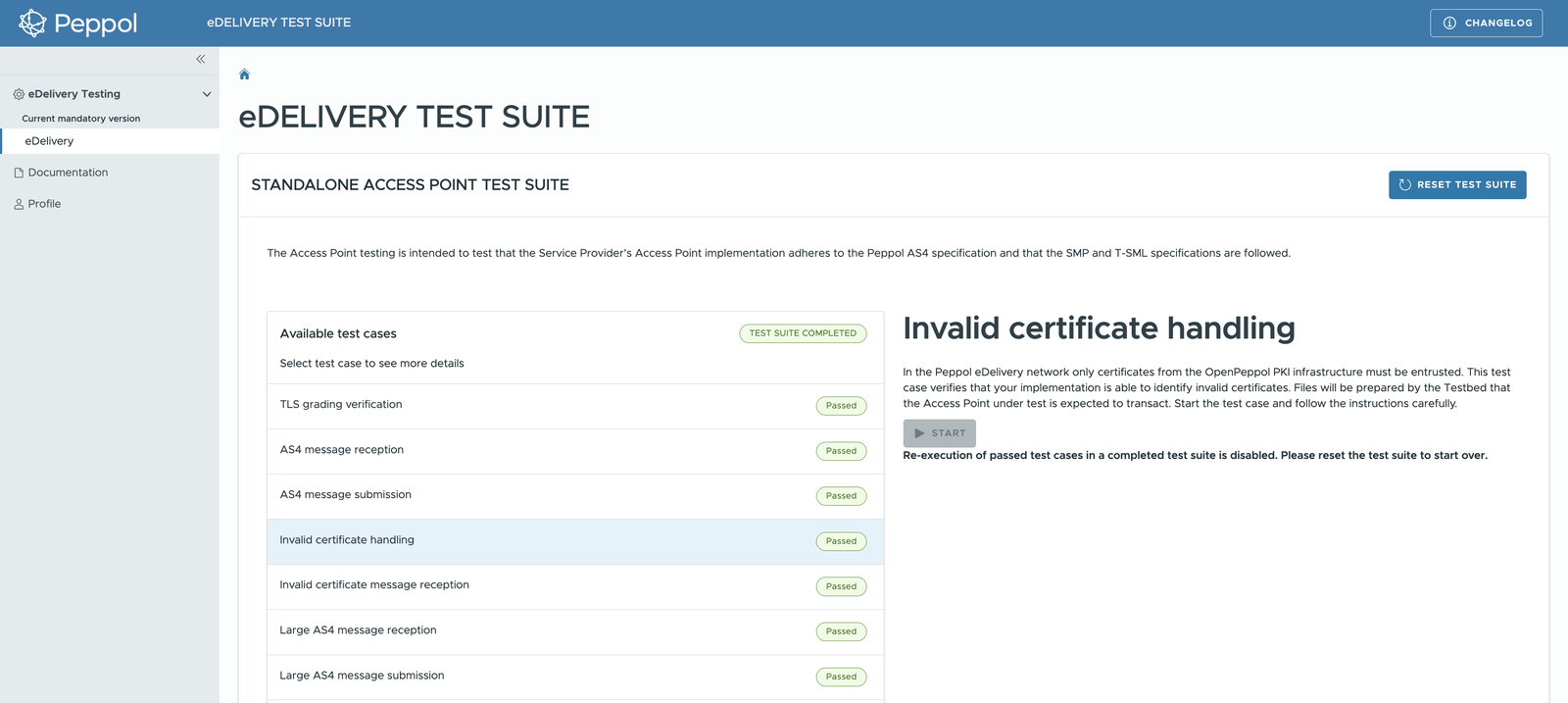
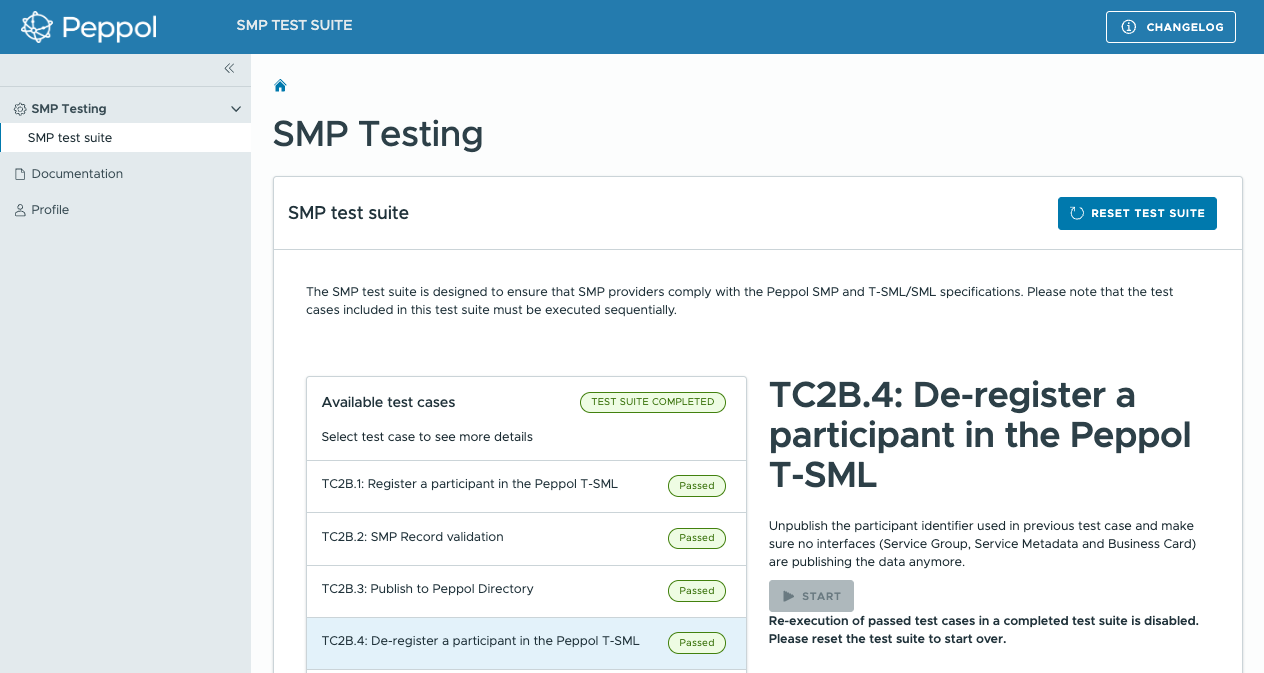
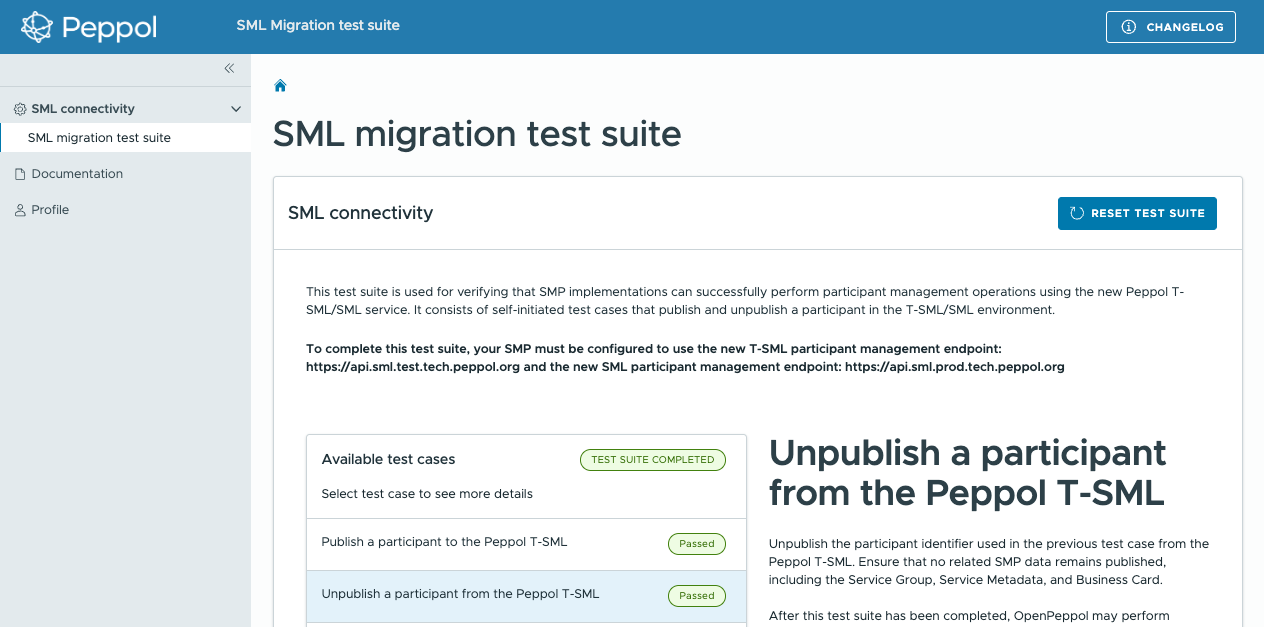
Every conformance suite a UAE access point is tested on, run against this platform and passed in full. These are the Testbed's own result screens from testbed.peppol.org.
 Full screen
PINT AE Billing 1.0.4
Invoices and credit notes
 Full screen
PINT AE Billing and AE TDD 1.0.4
Tax data documents to the FTA
 Full screen
PINT AE Self-Billing 1.0.4
Self-billed invoices
 Full screen
PINT AE Self-Billing and AE TDD 1.0.4
Self-billing tax reporting
 Full screen
eDelivery: standalone access point
AS4 transport and certificates
 Full screen
SMP test suite
Participant registration and lookup
 Full screen
SML migration
The new T-SML / SML endpoints
59/59
test cases passed across 7 Testbed suites. Select any screenshot to see it full size.
The Testbed is run per service provider, so you will run these suites under your own Peppol account as part of accreditation. The difference is that you run them on a stack that has already passed every one of them, with us alongside you.
The platform
Everything an access point has to operate.
Not a starter kit. This is the running system, the same one in the demo below.
Access point gateway
Invoice intake, TRN verification, per-tenant isolation, full status trace on every document.
PINT-AE validation
Real Schematron execution against the UAE rule set. Failures come back as specific rules, not a generic reject.
Peppol node and SMP
Transport, participant registration, reachability lookup, and message-level status handling.
Two consoles
One for you to run the access point, one for each customer to work in day to day.
Where you sit
The UAE runs a five-corner model.
Peppol's classic four corners, plus the Federal Tax Authority. As an access point you operate the two corners in the middle.
Supplier
Issues the invoice from their ERP or from a dashboard you host.
Supplier's access point
Validates against PINT-AE, converts to compliant XML, transmits, and reports to the FTA.
Buyer's access point
Receives over the network, validates, and returns a message-level status to C2.
Buyer
Gets a structured invoice into their own system, not a PDF to re-key.
Federal Tax Authority
The fifth corner is what makes the UAE model different from classic Peppol. C2 sends the FTA a Tax Data Document alongside every exchange. Getting that reporting obligation right is an access point's job, not the supplier's, and it is the part that has to be provably correct on day one of your accreditation.
What you operate
As an ASP you run C2 and C3 for every business you sign. HyperASP is that machinery: the gateway, the PINT-AE validator, the Peppol node and SMP registration, the FTA reporting path, and the consoles your customers work in.
Two consoles
One product, two audiences.
You are running a service business, so the software has to serve both you and the people you sell to.
For you
The access point console
Run the network side of the business from one place.
- Customer roster: onboard, suspend, offboard
- Peppol registration status per customer, with retry
- Throughput and failure rates across every customer
- Offboarding with migration keys, when a customer leaves
- Your branding across the whole deployment
For your customers
The business console
Where their finance team actually works, every day.
- Create and send invoices, validated before they go
- Inbox for documents received over the network
- Trading partners and product catalog
- Their own API tokens and webhook endpoints
- Full status trace on every document they send
Walkthrough
Watch both consoles at work.
Ten short videos, about five minutes each. Start with the first two for the UAE context, or jump straight to the part you care about.
01 / 10What Peppol means for UAE e-invoicing
Integration
Your customers connect however they need to.
Some have SAP. Some have Tally. Some have a spreadsheet and a person. All three have to work.
REST API
Available nowCreate, validate, send and track invoices directly. OAuth2 client-credentials, scoped service accounts.
Webhooks
Available nowSigned, retried delivery of every status change to your own endpoint, with a delivery log and replay.
Dashboard entry
Available nowFor customers with no system to integrate. They raise invoices in the console you give them.
For named ERPs, we build the connector against the customer's actual instance as part of the engagement. SAP, Dynamics, NetSuite, Odoo, Zoho, Tally, QuickBooks, Xero, or something in-house.
See the connector catalogEngineering
Built so no invoice is lost in flight.
An access point that drops documents loses its accreditation and its customers, in that order. This is the part of the system that gets designed first.
Nothing is lost in flight
Every stage hands off through a durable queue with a dead-letter path. A crashed worker resumes; it does not drop an invoice.
Retries with backoff
Transient failures retry on exponential backoff with jitter. Permanent failures stop immediately and surface the reason.
Idempotent throughout
Every event carries a deterministic id, so a redelivery is a no-op instead of a duplicate invoice.
Independently scalable
Validation, transport and reporting scale separately, so a validation backlog never blocks transmission.
Every document is archived and retrievable for audit, and every state change is recorded with a timestamp and the service that produced it. When a customer asks what happened to invoice 4471, the answer is a timeline, not an investigation.
Deployment
Your cloud. Optionally, your code.
The whole platform is defined as infrastructure-as-code, so it deploys into your AWS, GCP or Azure account rather than ours. Data residency is your decision to make and yours to answer for, which is the only workable answer when you are the regulated party.
Because it is code rather than a hand-built environment, a second region is a deployment rather than a project, and rebuilding the estate from scratch is a routine operation instead of a disaster recovery exercise you hope you never test.
Source-code ownership transfer is available where it matters to you. If your accreditation, your board or your customers need you to own the stack outright rather than depend on a vendor, that is a term we will write into the agreement.
Get started
See it running on real data, today.
Submit this and you'll be inside a live environment in under a minute, pre-loaded with invoices across the full lifecycle. No call required to look at it. When you want to talk about accreditation, deployment or commercials, that is a separate conversation and we're happy to have it.